
M

Search The One Ring

Khazad-dûm

How The Rings of Power's Khazad-dûm, the Dwarf city later called Moria, compares with Tolkien's Dwarrowdelf in the Second Age.

How Close to Tolkien?

Khazad-dûm, the Dwarrowdelf, is the great city of Durin's Folk under the Misty Mountains, which the Elves later called Moria. Tolkien has it grow richer after the First Age, trade its mithril with the Elven-smiths of Eregion, and come through the Second Age unconquered. The Balrog does not wake there until T.A. 1980, when it kills Durin VI. The Rings of Power keeps the city's place, its friendship with Eregion, the Doors of Durin made by Narvi, and the Dwarves who march out to help the Elves when Eregion falls. It changes the rest. Mithril is a new secret in Season 1, and an Elvish legend ties it to a lost Silmaril. In Season 2 quakes and hunger drive King Durin III to take a Ring, and the Balrog wakes and kills him while Eregion is under siege.

Exploring Tolkien app icon

Explore Tolkien. Every Day.

Read-throughs of Tolkien's books, deep conversations, videos, live chat, member-exclusives, and more.

QR code: scan with your iPhone camera to get the Exploring Tolkien app

Khazad-dûm in the Show and in Tolkien

Is Khazad-dûm the same place as Moria?

Unchanged

The Rings of Power

Yes. Khazad-dûm is the Dwarf kingdom of King Durin III under the Misty Mountains, a city of vast halls cut in the rock, and the Dimrill Dale lies outside it. Elrond first comes there in Season 1 to visit Prince Durin. The show only ever calls it Khazad-dûm. The names Moria and Dwarrowdelf are never spoken.
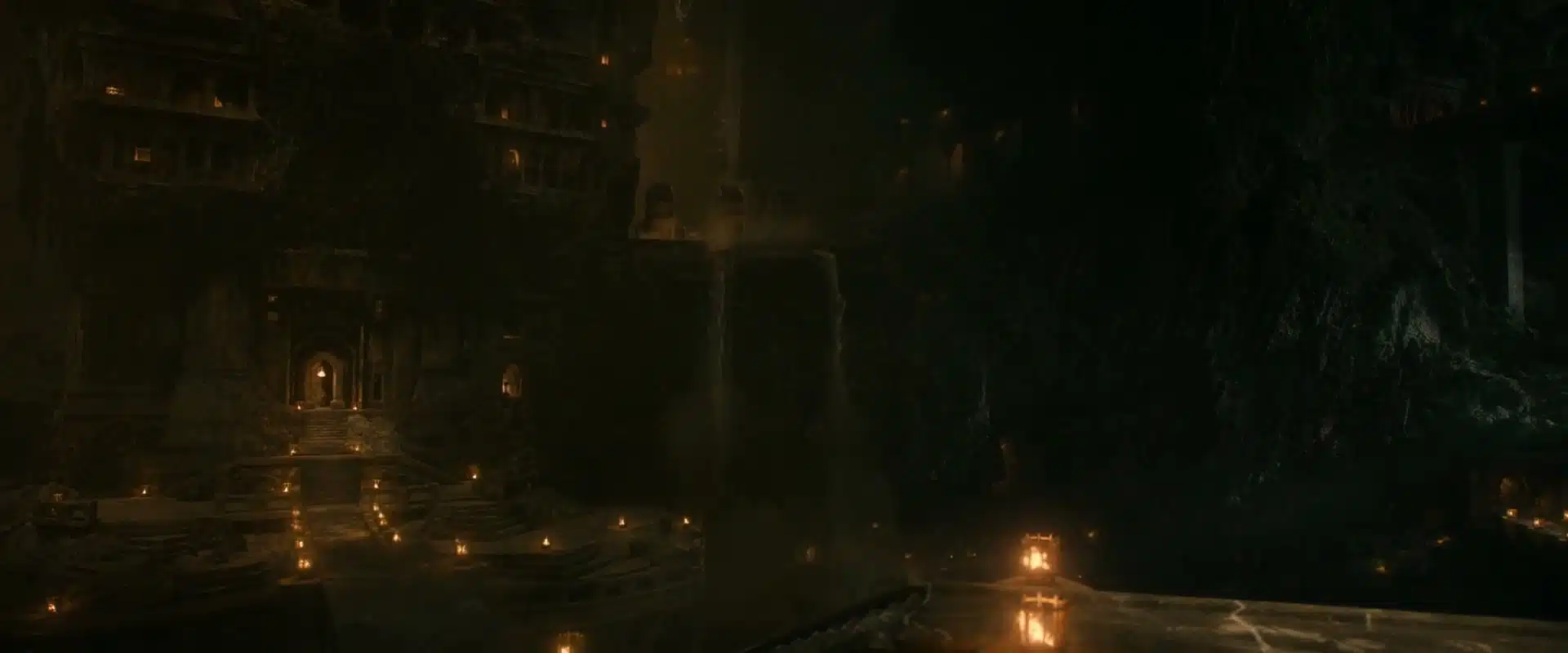
A vast dark cavern with carved buildings, stairs and small lights scattered across the floor

Tolkien

The Silmarillion calls Khazad-dûm the greatest of all the mansions of the Dwarves, Hadhodrond to the Elves, and says it was called Moria only later, in the days of its darkness. Dwarrowdelf, the Delving of the Dwarves, is the English form of the name. In The Fellowship of the Ring Gimli names the three peaks above it and tells the hobbits that the halls were once full of light and splendour.

The Silmarillion, "Of the Sindar"; The Fellowship of the Ring, "The Ring Goes South" and "A Journey in the Dark"

Was mithril a new discovery in the Second Age?

Changed

The Rings of Power

Prince Durin shows Elrond a new ore that Disa found while seaming for gold. He swears Elrond to secrecy, says the King has restricted mining it because it is perilous, and calls it the start of a new era for the Dwarves. In the same scene the two of them settle on its Elvish name, mithril. Later in Season 1 the King orders the shaft sealed.
Thin threads of pale blue light run through dark rock walls deep in a cavern

Tolkien

Appendix B says some of the Noldor went to Eregion, beside the West-gate of Moria, because they had learned that mithril had been found there. Eregion was founded around S.A. 750, so the metal was known for centuries before the Rings were made. Gandalf says Moria was the only place in the world where it was found, that it was worth ten times its weight in gold, and that the Elves loved it and made ithildin from it.

The Lord of the Rings, Appendix B; The Fellowship of the Ring, "A Journey in the Dark"

Verdict. Tolkien makes mithril the source of Khazad-dûm's wealth for long ages and the reason the Elven-smiths settled next door. The show turns it into a fresh find that the King keeps hidden, so the trade that built the friendship between the two peoples has no history behind it. The King's fear of digging is a fair nod to Gandalf's warning that the Dwarves went too deep.

Does mithril come from a Silmaril?

Changed

The Rings of Power

Gil-galad has Elrond recount an old legend, the Song of the Roots of Hithaeglir. An Elf and a Balrog fight over a tree in the Misty Mountains that holds the last lost Silmaril, lightning strikes it, and the power of their struggle runs down the roots into the mountain. The tale is called apocryphal, but Gil-galad says the Dwarves have found ore holding the Silmaril's light. Elrond tells Durin that without it the Elves must leave Middle-earth or fade away.

Tolkien

The Silmarillion ends the story of the three Silmarils plainly: one is carried in the sky by Eärendil, one is lost in the fires at the heart of the world, and one lies in the sea. None is hidden in a tree, and there is no Song of the Roots of Hithaeglir. Gandalf describes mithril as a metal, light and hard, that looks like silver and never tarnishes. Tolkien gives it no part in the fading of the Elves.

The Silmarillion, "Of the Voyage of Eärendil and the War of Wrath"; The Fellowship of the Ring, "A Journey in the Dark"

Verdict. The fate of the Silmarils is one of the few things The Silmarillion settles for good, and a fourth resting place undoes it. The showrunners told Vanity Fair, as CBR reported, that Tolkien gives mithril no origin and that they framed the legend as uncertain on purpose. Calling the tale apocryphal leaves room for doubt, but the plot treats the legend as true, and a viewer new to Tolkien will take the Silmaril in the mountain for something from the books.

Did quakes and hunger strike Khazad-dûm in the Second Age?

Changed

The Rings of Power

In Season 2 quakes from a distant fire-mountain collapse the sun-shafts that light Khazad-dûm's fields, and the crops fail. The Dwarves eat old bread, their children go hungry, and the Stone-singers can no longer find a safe path to dig. Disa says the King has always been slow to accept help from outside. Celebrimbor offers Rings in exchange for mithril, the King takes one, and with it he brings sunlight back into the mountain.
Seen past a crowned head, terraces of lit buildings fill a huge cavern under a shaft of light

Tolkien

Appendix A says the power and wealth of Khazad-dûm grew after the First Age, when people, lore and craft came to it from the ruined Dwarf-cities of Nogrod and Belegost. Gandalf says the Dwarves of Moria got most things they wanted by trade. Gimli's song tells of crystal lamps, and Gandalf knows of great windows and shafts to the light in the upper halls. Tolkien records no quakes, no famine, and no Stone-singers. The Silmarillion says the Dwarves used their Rings only to gather wealth, and the Rings woke in them anger and greed for gold.

The Lord of the Rings, Appendix A, "Durin's Folk"; The Fellowship of the Ring, "A Journey in the Dark"; The Silmarillion, "Of the Rings of Power and the Third Age"

Verdict. Tolkien's Khazad-dûm is at the height of its wealth when the Seven are made, and the Dwarves' fault is greed. The show makes the city desperate first, so the King takes his Ring to feed his people, and his later greed follows from a fair motive. It also adds the sun-shafts and the Stone-singers, which look like Dwarf lore but come from the show.

Were the Doors of Durin made in the Second Age?

Unchanged

The Rings of Power

Narvi unveils the Doors of Durin as the new West-gate of Khazad-dûm, with Elves and Dwarves looking on. The gate is said to be visible only by moonlight and to open to a password known only to friends. Celebrimbor speaks of the work as a friendship between the two peoples set in stone.

Tolkien

The inscription Gandalf reads on the West-gate names the Doors of Durin, Lord of Moria, asks a friend to speak and enter, and records that Narvi made them and Celebrimbor of Hollin drew the signs. The signs are of ithildin, made from mithril, which shows only in starlight and moonlight. Gandalf adds that in Durin's days the doors were not secret: they usually stood open, with guards sitting before them. Unfinished Tales names Narvi as Celebrimbor's greatest friend among the Dwarves, and The Silmarillion says a road ran from Eregion to this gate.

The Fellowship of the Ring, "A Journey in the Dark"; Unfinished Tales, "The History of Galadriel and Celeborn"; The Silmarillion, "Of the Rings of Power and the Third Age"

Did the Balrog wake under Khazad-dûm in the Second Age?

Changed

The Rings of Power

At the end of Season 1 the King seals the mithril shaft, and something burning stirs in the depths below. In Season 2, with his Ring, the King orders the dig doubled. Annatar visits the city and takes away mithril from its purest deposit yet. In the Season 2 finale Prince Durin fights his father in the mine to make him take off the Ring. The Balrog wakes, the King takes the Ring off, asks his son to forgive him, and is killed facing it, while Eregion is under siege.

Tolkien

Appendix A says the Balrog was a demon of Morgoth that fled from Thangorodrim and hid at the roots of the world. The Dwarves woke it while digging for mithril under Barazinbar, in the middle of the Third Age, and it killed Durin VI. The Tale of Years gives T.A. 1980, more than three thousand years after Eregion fell. His son Náin I was killed the next year, and the Dwarves fled. Gandalf says they delved too greedily and too deep and disturbed Durin's Bane. Of Durin III, Appendix A says only that the Dwarves believed the Elven-smiths gave him his Ring, with Sauron's evil on it. The Silmarillion says the Dwarves could not be dominated by their Rings.

The Lord of the Rings, Appendix A, "Durin's Folk", and Appendix B, "The Tale of Years"; The Fellowship of the Ring, "A Journey in the Dark"; The Silmarillion, "Of the Rings of Power and the Third Age"

Verdict. The show keeps Tolkien's cause, Dwarves digging too greedily for mithril, but moves it into the Second Age and gives the death to Durin III. Tolkien's Khazad-dûm stands for more than three thousand years after Eregion falls, and the Balrog that finally drives Durin's Folk out takes its name, Durin's Bane, from Durin VI. A Ring that takes over the King's mind also goes further than Tolkien, who says the Dwarves would not endure being ruled by another and that their Rings bred greed in them.

Did Khazad-dûm help the Elves when Eregion fell?

Unchanged

The Rings of Power

Prince Durin rallies the warriors of Khazad-dûm to march for Eregion, but the army is recalled to save the city, and the Elves outside Eregion's walls hear that its gate is shut. In the finale a Dwarf host comes to the battle without the prince, who is mourning his father, and Sauron is told the Dwarves are covering the Elves' retreat. Durin then sends word to Elrond's survivors in a northern valley that Khazad-dûm will help them again.
A Dwarf stands on a stone ledge between rock walls with one fist raised

Tolkien

Unfinished Tales says that after Eregion fell, Sauron turned on the few Elves Elrond had gathered, and they would have been overwhelmed if Durin had not sent Dwarves out of Khazad-dûm, with Elves of Lórinand under Amroth, to attack Sauron's host from behind. Elrond escaped north to found Imladris. Sauron drove the Dwarves back, but the Gates of Moria were shut, he could not get in, and he hated Moria ever after. Appendix A adds that the city's halls were too deep and strong and its people too many and brave for Sauron to take.

Unfinished Tales, "The History of Galadriel and Celeborn"; The Lord of the Rings, Appendix A, "Durin's Folk", and Appendix B, "The Tale of Years"

Common Questions

Is Khazad-dûm the same as Moria?

Yes. Khazad-dûm is the Dwarves' own name for the city under the Misty Mountains. The Elves called it Hadhodrond, and later Moria, the Black Pit, after it was abandoned. Dwarrowdelf is the English form. The Rings of Power uses only Khazad-dûm.

Does mithril come from a Silmaril in Tolkien?

No. Tolkien never gives mithril an origin, and The Silmarillion says the three Silmarils ended in the sky, in the fire of the earth, and in the sea. The legend of a Silmaril in a tree under the Misty Mountains was written for The Rings of Power.

When did the Balrog wake in Khazad-dûm?

In T.A. 1980, according to Appendix B of The Lord of the Rings, when it killed Durin VI. The Rings of Power has it wake at the end of Season 2, in the Second Age, and kill Durin III.

Who made the Doors of Durin?

Narvi, a Dwarf of Khazad-dûm, made them, and Celebrimbor of Eregion drew the signs on them, according to the inscription Gandalf reads in The Fellowship of the Ring. The Rings of Power shows Narvi unveiling them in Season 2.

Did Sauron ever take Khazad-dûm?

No. Appendix A says the city was too deep and strong for Sauron to conquer from outside, and it held out through the Second Age. The Dwarves left it in the Third Age, after the Balrog woke.