M

Search The One Ring

The Fading of the Elves

How The Rings of Power's fading of the Elves, a Second Age crisis cured with mithril, compares with the slow fading Tolkien wrote about.

How Close to Tolkien?

The fading of the Elves is Tolkien's own idea. The Elves are bound to the world, and as the ages pass and Men grow, those who stay in Middle-earth wane and grow weary, and in the end they either sail into the West or dwindle into a hidden, rustic folk. Tolkien makes it a slow sorrow that comes to a head at the end of the Third Age, when the One Ring is destroyed and the power of the Three ends. The Rings of Power keeps the word, Galadriel's picture of Elves dwindling into shadows, and the link between the Three Rings and the holding back of time. The rest is different. Gil-galad finds the light of the Eldar failing in the Second Age, a blighted Great Tree in Lindon shows it, and the Elves must leave by spring or perish unless mithril, which holds the light of a lost Silmaril, can save them. That crisis is the show's reason for making the Rings, and Gil-galad is the one who demands them.

The Fading of the Elves in the Show and in Tolkien

Is the fading of the Elves in Tolkien?

Kept from Tolkien

The Rings of Power

Yes. In Season 1, episode 5, Gil-galad tells Elrond that the light of the Eldar is failing and that the decline is growing faster. Elrond later explains it to Prince Durin IV: without help, the Elves' immortal souls will shrink little by little until they are shadows, carried off by time. In Season 2, episode 1, Gil-galad sings a lament for the Elves and then tells Lindon that their days in Middle-earth are over.
Gil-galad in a gold cloak stands beneath bare branches against a grey cloudy sky

Tolkien

Yes. The Silmarillion says the Elves last as long as the world, and that their love of it grows more sorrowful as the years lengthen. In later days, it says, the Elves who stayed in Middle-earth waned and faded, kept to woods, caves, and starlight, and became like shadows and memories, while others sailed into the West. In Lothlórien Galadriel tells Frodo that if he succeeds her land will fade, and the Elves must go West or dwindle to a rustic folk who forget and are forgotten. After the coronation Gandalf tells Aragorn that in the Dominion of Men the Elder Kindred will fade or depart. Elrond's words to Durin follow Galadriel's picture closely.

The Silmarillion, "Of the Beginning of Days" and "Of Men"; The Lord of the Rings, Book II, "The Mirror of Galadriel"; Book VI, "The Steward and the King"
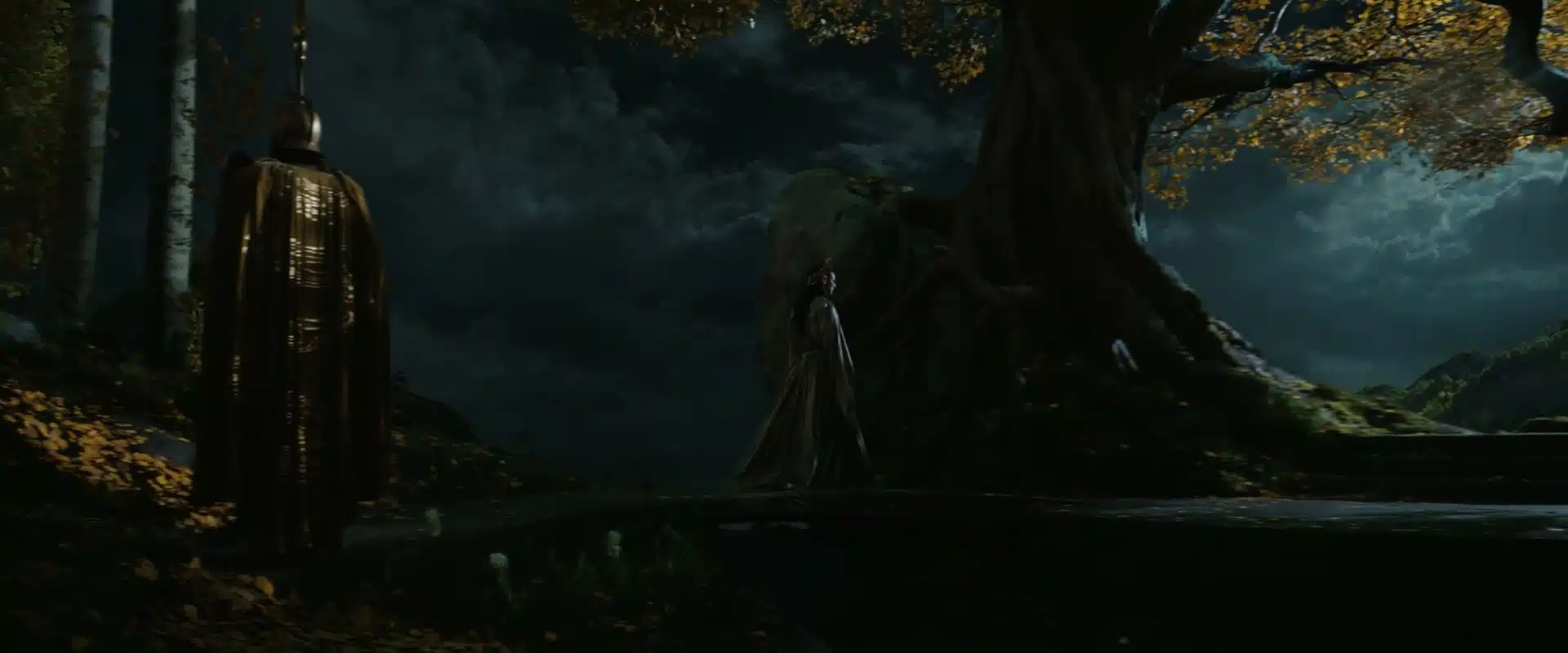
Did the Elves begin to fade in the Second Age?

Changed from Tolkien

The Rings of Power

Yes, and quickly. Gil-galad tells Elrond he first noticed the decay just before Galadriel came back from her hunt for Sauron, and that he sent her to the West partly in the hope that ending the last of the fighting would stop it. It did not, and the decline has grown faster since. Only a few in Lindon know. In Season 1, episode 8, Gil-galad says the eruption of the mountain of fire has made it worse.
A robed figure walks toward a massive tree on a cliff edge under a stormy night sky, a lamp hanging nearby

Tolkien

Tolkien gives the Second Age a slower sorrow with no crisis. The Akallabêth, the part of The Silmarillion that tells the fall of Númenor, says Middle-earth went backward and its light and wisdom dwindled while Númenor rose. In Unfinished Tales Galadriel tells Celebrimbor, before Sauron deceived the smiths, that she grieves because leaves fall and flowers fade in Middle-earth. Nothing says the Elves were dying. The real turn comes at the end of the Third Age. The Silmarillion says the Elves long foresaw that the power of the Three would fail once the One was found or destroyed, and that they would then pass into the twilight. When Aragorn took up the kingship, the power of the Three was ended, and to the Firstborn the world grew old and grey.

The Silmarillion, "Akallabêth" and "Of the Rings of Power and the Third Age"; Unfinished Tales, "The History of Galadriel and Celeborn"

Verdict. Tolkien's fading is the long grief of a people who love a world that changes around them, and it grows sharp only when the Three lose their power at the end of the Third Age. The show makes it an illness that strikes in the Second Age and must be cured within a season. Galadriel's wish to keep Middle-earth from changing, the desire Sauron later used against Eregion, has no place in it, and the show's Elves want the Rings in order to survive.

Did the Elves have to leave Middle-earth or perish?

Changed from Tolkien

The Rings of Power

Yes. Elrond tells Durin IV that without mithril the Elves must leave by spring or perish. When Celebrimbor's first attempts fail in Season 1, episode 8, Elrond says the Elves must make ready to leave forever. In Season 2, episode 1, Gil-galad tells Lindon that the Elves must go home to Valinor or diminish into endless night. He also warns that if the Elves go, the armies of darkness will overrun every people in Middle-earth.
Gil-galad in gold robes and Elrond in a teal cloak stand on a clifftop under a pale sky as Galadriel looks on

Tolkien

No. Going West is a choice, and Tolkien never sets a date for it. When Sauron, as Annatar, flatters the Elves of Eregion, he says they must love Middle-earth, since they have not gone back to the West though they could. Círdan's ships at the Havens carry those who grow weary of the world, and the Three keep Rivendell and Lórien unstained while the Third Age lasts. Even after the Three fail, Elves remain. Appendix B says the Silvan Elves lived untroubled in the Greenwood in the Fourth Age, and Celeborn stayed for some years after Galadriel left before he went to Rivendell.

The Silmarillion, "Of the Rings of Power and the Third Age"; The Lord of the Rings, Appendix B, "The Tale of Years"

Verdict. Tolkien's Elves choose between leaving the land they love and staying to grow less in it, and both roads are sad. The show's Elves face death by a fixed season, and the fading works as a clock for the plot. The choice that Tolkien puts before every Elf in Middle-earth, and the sorrow in it, is lost.

Did a dying tree in Lindon show the Elves' fading?

Changed from Tolkien

The Rings of Power

Yes. Gil-galad shows Elrond a blight on a great tree in Lindon and calls it the outward sign of the Elves' failing light. In Season 1, episode 2, Durin IV and Disa are growing a sapling that Elrond says comes from the Great Tree in Lindon, the symbol of the Elves' strength. By Season 1, episode 8, the tree is losing its leaves, and in Season 2, episode 1, Gil-galad says the Elves will leave when the last golden leaf falls. In Season 2, episode 3, Celebrimbor tells the Dwarves that the Rings have healed it.
Elrond in a blue cloak stands by the gnarled trunk of a great tree while Gil-galad waits among lit birches

Tolkien

No Great Tree of Lindon appears in The Silmarillion, Unfinished Tales, or The Lord of the Rings. The tree bound to a people's fate is Nimloth, the White Tree of Númenor, descended from Telperion and kept as a memorial of the Eldar and the light of Valinor. Tar-Palantir foretold that the line of the kings would end when it died, and Sauron urged Ar-Pharazôn to cut it down. Isildur saved a fruit, and the tree grown from it was planted in Minas Ithil. The trees of Lórien that bore golden flowers were kept by Nenya, and after Galadriel left there was no more light or song in Caras Galadhon.

The Silmarillion, "Akallabêth" and "Of the Rings of Power and the Third Age"; The Lord of the Rings, Appendix B, "The Tale of Years"

Verdict. Tolkien's White Tree carries the hope of Númenor and of Elendil's line, and its felling shows how far the kings have turned against the Valar. The show gives the Elves a tree of their own that sickens and recovers like a patient. A sign of a royal line and its loyalty to the Valar becomes a gauge of the Elves' health.

Was mithril the cure for the Elves' fading?

Changed from Tolkien

The Rings of Power

Gil-galad believes so. He has Elrond tell an old legend in which a fight between an Elf and a Balrog over a tree holding the last Silmaril sent a power down into the mountain, and he says the Dwarves have found the ore that holds the Silmaril's light. Elrond tells Durin IV that the Elves came for mithril because without it they will perish. Gil-galad later compares the Elves to coals taken too long from the hearth, who must go back to Valinor. In Season 2, episode 3, Celebrimbor tells King Durin III that mithril has reversed the Elves' fortunes. Showrunner J.D. Payne has said the mithril legend was a way to join the light of the Trees, the Silmarils, the Three Rings, and the fading of the Elves into one idea.
Gil-galad in gold robes raises a finger in an autumn forest while Galadriel in green stands behind

Tolkien

No. Tolkien never ties the fading to mithril or to the light of a Silmaril. Gandalf says mithril was found only in Moria and was worth ten times its weight in gold, and that the Elves loved it and made ithildin from it. The Dwarves' greed for it woke Durin's Bane. The Silmarillion ties the fading to the long ages and to the rise of Men, after Elves and Men grew estranged.

The Lord of the Rings, Book II, "A Journey in the Dark"; The Silmarillion, "Of Men"

Verdict. Tolkien's Elves want mithril because they love fine work, and the Dwarves' greed for it is what wakes the Balrog. The show makes the metal a medicine, so every bargain between Elves and Dwarves is about staying alive, and the sorrow Tolkien gave the Elves becomes a problem that ore from a mine can solve.

Were the Three Rings made to hold back the fading?

Kept from Tolkien

The Rings of Power

Yes. In Season 2, episode 1, Gil-galad is told that Elrond carries three Rings that can stop the fading and save the Elves. In Season 2, episode 2, Halbrand tells Celebrimbor that the Rings worked wonders in Lindon, and in Season 2, episode 6, Adar tells Galadriel he has heard that the Three saved her people from fading.

Tolkien

In large part, yes. The Silmarillion says those who held the Three could ward off the decay of time and put off the weariness of the world, and that while the Third Age lasted, Rivendell and Lórien stayed unstained by the griefs of time. The Noldor of Eregion took up Annatar's teaching because they wanted to stay in Middle-earth and yet keep the bliss of those who had gone West. At the Council of Elrond, Elrond says that once the One is gone the Three may fail, and many fair things will fade. The Three were made to preserve, and the show keeps that purpose.

The Silmarillion, "Of the Rings of Power and the Third Age"; The Lord of the Rings, Book II, "The Council of Elrond"

Did Gil-galad want the Rings to save the Elves?

Changed from Tolkien

The Rings of Power

Yes, in the end. In Season 1, episode 8, Gil-galad hears Celebrimbor's plan for a new kind of power, which Halbrand helped to shape, and calls it perilous. Because the tree is nearly bare, he orders Celebrimbor to close the city and bring everyone back to Lindon, and Celebrimbor asks for three months. In Season 2, episode 1, after he learns that Halbrand is Sauron, Gil-galad still demands the finished Rings from Elrond, calls them the last hope of Middle-earth, and has Elrond seized when he refuses. Elrond wants them destroyed. By Season 2, episode 2, the Rings are being worn, and Elrond tells their bearers that they have made themselves Sauron's collaborators.

Tolkien

No. Gil-galad and Elrond distrusted Annatar from the start, and Lindon sent messengers to warn the other Elves against him. Annatar complains to the smiths of Eregion that the two will not help him. Celebrimbor made the Three alone. When Sauron's treachery was known, the Three were given to the Wise, who hid them and never used them openly while he held the One. Gil-galad did later bear Vilya, but nothing says he sought the Rings or needed them to save his people.

The Silmarillion, "Of the Rings of Power and the Third Age"; Index of Names, "Vilya"

Verdict. Tolkien's Gil-galad sees through Annatar when the smiths of Eregion do not, and the Three stay hidden from use until Sauron loses the One. The show's Gil-galad knows who helped Celebrimbor and wants the Rings anyway because his people are dying, and the Three go onto Elven hands at once. The wisdom that set Lindon apart from Eregion is gone.

Common Questions

What is the fading of the Elves in Tolkien?

Tolkien's Elves live as long as the world lasts, but those who stay in Middle-earth grow weary and wane as the ages pass and Men grow. In the end they either sail into the West or dwindle into a hidden folk. Galadriel and Gandalf both speak of it in The Lord of the Rings.

When do the Elves fade in Tolkien?

Slowly, over the ages. It comes to a head at the end of the Third Age, when the One Ring is destroyed and the power of the Three Rings ends. The Rings of Power moves the crisis into the Second Age.

Did mithril save the Elves from fading?

Not in Tolkien. He never ties the fading to mithril. In The Rings of Power, Gil-galad believes mithril holds the light of a lost Silmaril and can save the Elves, and the Three Rings are made with it.

Is the Great Tree of Lindon in Tolkien?

No. The Great Tree of Lindon is the show's own. The tree in Tolkien whose fate is bound to a people is Nimloth, the White Tree of Númenor.

Did the Three Rings stop the Elves from fading?

In Tolkien, the Three could hold off the decay of time, and they kept Rivendell and Lórien unstained through the Third Age. When the One was destroyed, their power ended, and the last of the Noldor sailed from Middle-earth.